You can sharpen your bread knife at home if you have the right tools and use care. Many people think you cannot sharpen serrated knives, but that is not true. You just need to be patient and use the right way to keep your bread knife sharp and ready.
Some people think serrated knives cannot be sharpened because of their special edges.
Others try to use normal sharpening stones, but these do not work well on these blades.
Many people throw away dull knives, but sharpening them saves money and helps cut down on waste.
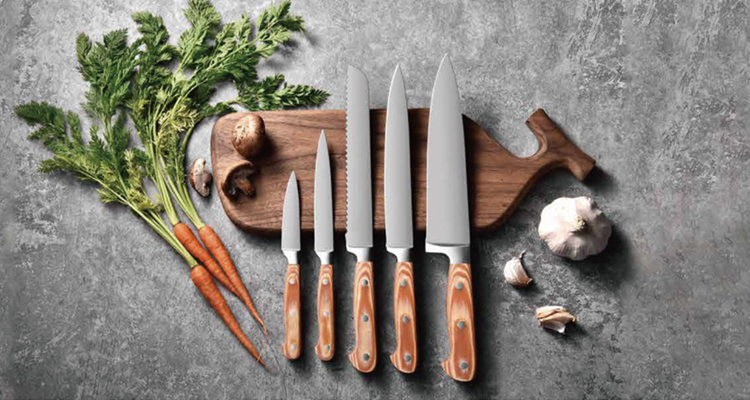
If you want to sharpen a serrated knife, you should use a ceramic or diamond rod that fits the serrations. GARWIN makes high-quality bread knives and other kitchen tools, like chef knife and utility knife, that last a long time and are easy to take care of.
Use a ceramic or diamond rod that fits the serrations. This helps you sharpen your bread knife safely and well.Check if your knife is sharp by slicing bread or tomatoes. Feel the serrations with your fingers. A sharp knife cuts cleanly and needs little pressure.Sharpen each serration slowly with gentle strokes. Match the rod angle to the bevel side of the blade.Take care of your knife by washing it by hand. Dry it right away. Hone it often with a ceramic rod. Store it in a safe place.Do not sharpen damaged or cheap knives by yourself. It is better to get them sharpened by a professional or buy a new one.
Check Bread Knife Sharpness
Signs of a Dull Serrated Bread Knife
You can spot a dull serrated knife by looking for a few clear signs.
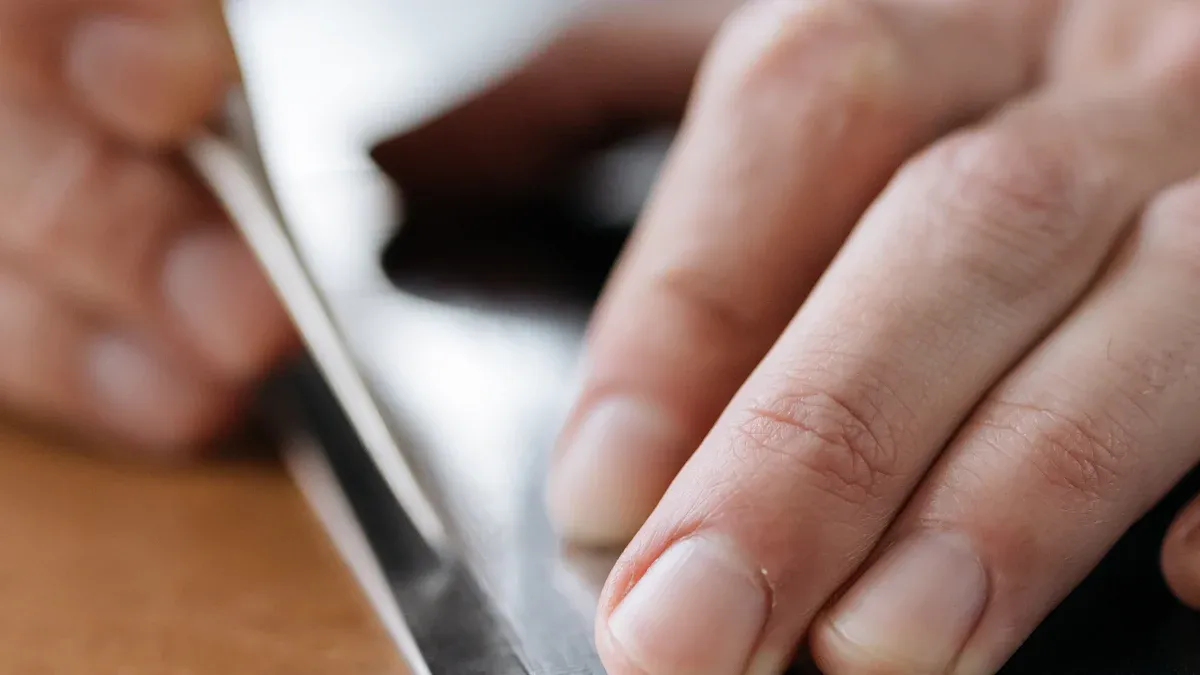
The edge of the blade looks shiny or polished instead of matte. This shine means the serrations have rounded off.
When you touch the edge, it feels smooth instead of slightly rough or "tacky."
You notice that the knife crushes or tears bread, tomatoes, or other soft foods instead of slicing cleanly.
The slices come out jagged or uneven.
You need to use more pressure to cut through food.
The knife tears paper instead of slicing it smoothly during a paper test.
Tip: A sharp serrated bread knife should glide through crusty bread and soft tomatoes with little effort. If you see crumbs everywhere or the bread gets squashed, your knife likely needs sharpening.
At-Home Sharpness Tests
You can check the sharpness of your serrated knife at home with a few simple tests. Experts recommend these steps:
Slice through a crusty loaf, like a boule or baguette. A sharp knife cuts the crust and soft inside with even, clean slices.
Try slicing a ripe tomato. If the knife squashes the tomato or leaves jagged edges, it is dull.
Cut a fresh sandwich loaf. The knife should make smooth, consistent slices without compressing the bread.
Use the thumb test. Carefully run your wet thumb across the serrations. A sharp edge feels slightly rough and "bites" at your skin, while a dull one feels smooth.
Observe how much pressure you need. A sharp serrated knife cuts with minimal force.
For a quick check, try slicing a piece of paper. A sharp knife will cut cleanly and quietly, but this test is less reliable than using real food.
You can also look at the blade under a bright light. Dull spots reflect more light and may show small nicks or dents. Testing your knife on actual food, like bread or tomatoes, gives you the best sense of its sharpness and performance.
If you want to keep all your kitchen tools in top shape, remember that GARWIN offers a full range of products, including chef knives and utility knives, designed for easy maintenance and long-lasting sharpness.
Tools for Sharpening a Serrated Bread Knife
Sharpening Rods and Stones
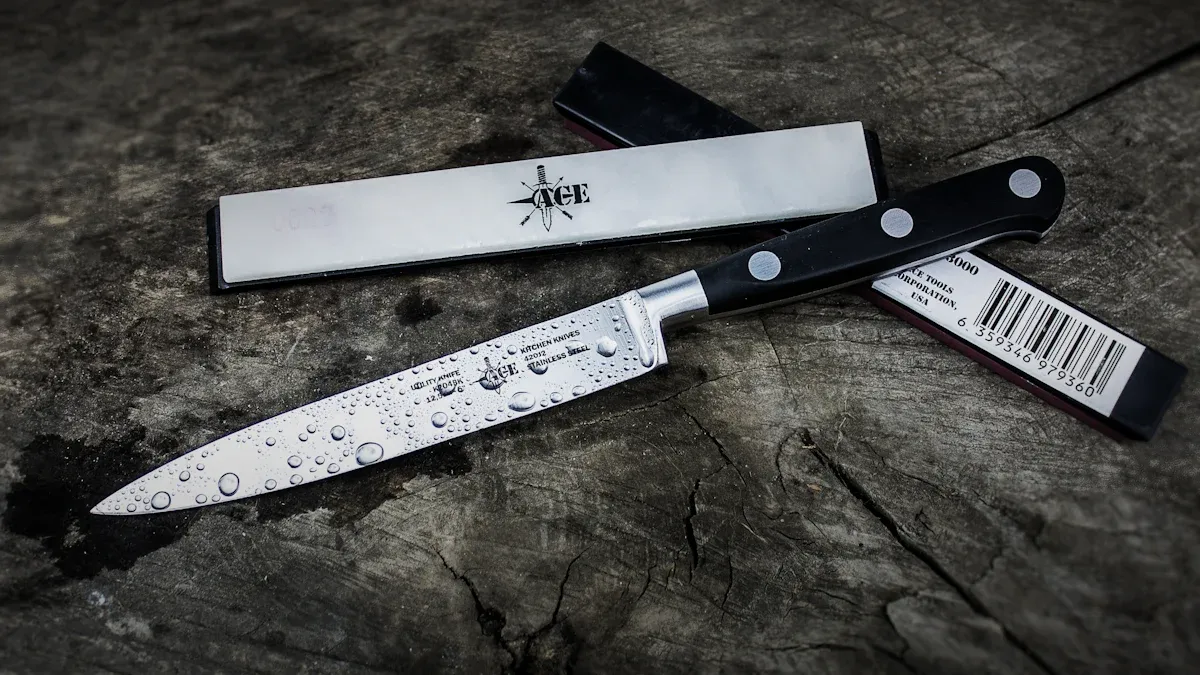
To sharpen a serrated knife, you need special tools. Regular sharpening stones do not work well on these knives. Most chefs and experts use a ceramic or diamond rod. These rods fit into the grooves of the serrations. Ceramic rods are gentle and good for regular care. They help keep the edge straight without taking off much metal. This makes your bread knife last longer. Diamond rods are rougher and work best for very dull or damaged blades. Use diamond rods carefully so you do not wear down the teeth.
Here is a simple chart about sharpening tools:
Tool Type | Best Use | Notes |
Ceramic Sharpening Rod | Regular honing and maintenance | Safe for beginners, gentle on metal |
Diamond-Coated Rod | Restoring very dull or damaged serrated knives | Removes metal quickly, use sparingly |
Tapered Diamond Rod | Fits different serration sizes | Matches each groove for best results |
Chainsaw File | Precise control for large serrations | Must match the size of the serration |
Tip: Pick a rod or file that fits the serration size for the best results.
GARWIN bread knives are made from strong materials like stainless steel and high-carbon steel. These materials make sharpening easier and help the blade stay sharp longer. GARWIN also makes chef knives and utility knives. These are easy to care for and stay sharp for a long time.
Sandpaper and Household Alternatives
If you do not have a sharpening rod, you can use things from home. One way is to wrap fine sandpaper around a wooden dowel. Put the dowel in each serration and move it back and forth gently. This helps keep the teeth in shape and is good for small touch-ups.
You can also use a water stone to finish the flat side of the blade. After sharpening, a small burr may appear on the flat side. You can remove this by gently rubbing the flat side on a fine water stone or by stropping it on leather.
Note: Always clean your sharpening tools after you use them. Store them in a dry place. This keeps them working well for next time.
If you use the right tools and take your time, your serrated knife will stay sharp and ready for any job in the kitchen.
How to Sharpen a Serrated Knife
Sharpening a serrated knife at home may seem tricky, but you can do it with patience and the right tools. Follow these steps to restore your bread knife’s cutting power and keep it working like new.
Match Rod to Serrations
Before you start, you need to choose a sharpening rod that fits the size of your knife’s serrations. The rod should match the diameter of the gullets (the curved spaces between the teeth). If the rod is too thick, it will not fit into the grooves. If it is too thin, it will not sharpen the edge well.
To find the right rod:
Look at the serrations on your bread knife. Most bread knives work well with ceramic rods between 8-13mm in diameter. For larger, deeper serrations, use a rod closer to 13-14mm. For fine, small serrations, a sharpening pen around 6mm works best.
The rod should fit snugly into each groove without forcing it. This helps you sharpen a serrated knife without damaging the teeth.
Many sharpening rods have a tapered shape. You can use the thinner or thicker part to match each serration.
Tip: Always clean your knife before sharpening. This helps you see the serrations clearly and keeps your hands safe.
Sharpen Each Serration
Now you are ready to sharpen. Place your bread knife flat on the edge of a table or a sturdy surface. This keeps the knife steady and helps prevent accidents.
Follow these steps to sharpen a serrated knife:
Hold the sharpening rod in your dominant hand.
Find the beveled side of the blade. Most serrated knives have one side that is angled (the bevel) and one side that is flat. You will sharpen only the beveled side.
Insert the rod into the first serration. Make sure it fits the groove.
Gently move the rod back and forth along the length of the serration. Use short, controlled strokes. Do not use too much pressure. Let the rod do the work.
Adjust the angle of the rod to match the shape of the serration. Keep the rod at the same angle as the bevel, usually between 13-17 degrees.
Repeat this process for each serration along the blade. Take your time and do not skip any teeth.
After sharpening all the serrations, check the edge by carefully feeling for sharpness or testing on a piece of bread.
Safety Reminder: Always move the rod away from your body. Keep your fingers clear of the blade. Use gentle pressure to avoid damaging the serrations.
Common mistakes include using an electric sharpener not made for serrated knives, sharpening the flat side, or pressing too hard. Focus on each serration for the best results.
Remove Burrs and Finish Edge
After you sharpen a serrated knife, you may notice a small burr (a thin piece of metal) on the flat side of the blade. Removing this burr is important for a smooth, clean cut.
To finish the edge:
Lay the flat side of the knife on a fine-grit sharpening stone or use a leather strop.
Make a few light passes at a shallow angle (about 10 degrees) to remove the burr. Do not press hard. You only need to polish the edge.
You can also use fine sandpaper wrapped around a flat surface for this step.
For extra sharpness, pull the knife backwards along a leather strop, moving away from the edge.
Note: Regular honing with a ceramic rod helps keep your bread knife sharp longer. Store your knife in a block or on a magnetic strip to protect the edge.
If you have questions about how to sharpen a serrated knife or need help with knife care, GARWIN offers after-sales support and expert advice. GARWIN bread knives, chef knives, and utility knives use high-quality materials that make sharpening and maintenance easy. You can explore more kitchen knife options and find the right tools for your needs at GARWIN’s product page.
When Not to Sharpen a Bread Knife
Low-Quality or Damaged Knives
Do not sharpen bread knives if they are low-quality or damaged. These knives might have weak steel or bad serrations. Trying to sharpen them can make things worse. Here are some risks you might face:
Serrated bread knives have teeth that need careful sharpening. If you use the wrong way, you can wear down or flatten the serrations. This makes the knife bad at slicing bread.
Using the wrong tools or ways can make the edge uneven. This can cause jagged or rough cuts.
Bad or damaged blades can chip or bend when you sharpen them. This makes the knife unsafe.
Pressing too hard or using the wrong angle can hurt the blade. Sharpening too fast can also cause damage.
Keeping serrated edges sharp needs skill and the right tools. Without these, the knife will not last as long or work well.
For damaged or delicate serrated knives, it is safer to get them sharpened by a professional.
Tip: If your bread knife has bent, broken, or missing teeth, or deep chips, it is better to replace it than sharpen it.
Alternatives: Professional Sharpening or Replacement
Sometimes, sharpening at home is not the best idea. You might want to use a professional sharpening service for expensive knives or perfect results. Professionals have special tools and know how to fix serrated edges without harm.
Here is a quick cost comparison:
Sharpening Method | Cost Details | Notes |
DIY Sharpening Set | One-time cost around $50 | Can be used many times, good if you do not sharpen often or have few knives |
Professional Sharpening | $75 to $100 for a few sharpenings per year | Price depends on how many knives and what kind |
Per Knife Professional Fee | $2 to $4 per knife for regular sharpening | Extra fees may be added for repairs or special work |
Additional Professional Fees | $5 to $20 for repairs (bent, broken, chipped blades), $10 for blade thinning | Extra costs for more than just sharpening |
Online Professional Service | Around $14.75 per knife including shipping | Shipping makes the total price higher |
Professional sharpening costs more for each knife, but it is easy and gives good results. If you sharpen lots of knives, a DIY kit saves money over time. But you need to be careful and patient to avoid mistakes.
If your bread knife cannot be fixed, getting a new GARWIN bread knife is safer and works better. You can also look at other GARWIN knives, like chef knives and carving knives, to upgrade your kitchen. Taking care of your serrated bread knife and getting it sharpened by a pro helps your tools last for years.
Maintain a Serrated Bread Knife
Regular Honing and Cleaning
You can keep your serrated bread knife sharp and safe with a few simple habits. Always hand wash your knife with warm water and mild soap. Dishwashers can cause the blade to bend, chip, or dull. After washing, dry the knife right away with a soft cloth. This step prevents rust and keeps the blade looking new.
For best results, hone your knife regularly. Use a ceramic rod to realign the serrated edges. Run the rod through each serration every few uses, especially before cutting crusty bread. This quick tune-up helps maintain sharpness between full sharpenings. If you use your knife often, plan to sharpen it every two months. For heavy use, consider professional sharpening once a year.
Follow these steps for routine care:
Hand wash with hot water and soap.
Dry thoroughly after each wash.
Apply a light coat of mineral or neutral cooking oil to the blade to prevent rust.
Use a ceramic rod to hone the serrations as needed.
Avoid cutting frozen or hard foods to protect the teeth.
Tip: Use a wooden or soft plastic cutting board. Hard surfaces like glass or marble can wear down the serrations quickly.
Safe Storage and Handling
Proper storage keeps your knife sharp and safe. Store your serrated bread knife in a wooden block, on a magnetic strip, or in a blade cover. These options protect the blade from damage and keep it dry. Avoid tossing knives into drawers. Loose storage can cause the blade to hit other utensils, which dulls the edge and may chip the teeth.
Here are some safe storage options:
Knife block: Keeps knives organized and prevents accidents.
Magnetic strip: Saves counter space and allows airflow to prevent moisture buildup.
Blade cover or sheath: Good for drawer storage and travel.
Clean your storage units often. Make sure wooden blocks stay dry to avoid mold. Always place the knife with the blade facing up or resting on its spine to prevent dulling.
Note: Proper storage and regular care help your bread knife, chef knife, and utility knife last longer and perform better.
Sharpening your bread knife at home is easy if you have the right tools and follow each step carefully. Taking care of your bread knife and other kitchen tools, like a chef knife or utility knife, helps them work well and keeps you safe. If you are not sure what to do, you can ask experts like GARWIN for help or try these professional services:
Mobile sharpening services come to you and have skilled workers.
Knife exchange programs bring sharp, clean knives right to your kitchen.
There are special options for homes and businesses.
Keep your kitchen tools in good shape and feel good using a sharp, trusty bread knife.
FAQ
How often should you sharpen a bread knife?
You should sharpen your bread knife every few months if you use it often. Light users can sharpen it once or twice a year. Regular honing helps keep the edge sharp between full sharpenings.
Can you use a regular sharpening stone on a serrated bread knife?
You should not use a flat sharpening stone on serrated knives. Use a ceramic or diamond rod that matches the serrations. This method protects the teeth and keeps your bread knife sharp for longer.
What is the best way to store a bread knife?
Store your bread knife in a knife block, on a magnetic strip, or with a blade cover. Safe storage prevents damage and keeps the edge sharp. This also works well for chef knives and utility knives.
Can you sharpen other serrated knives the same way?
Yes, you can sharpen other serrated knives, like sandwich knives, using the same method. Always match the sharpening rod to the size of the serrations for best results.
Where can you find high-quality bread knives and sharpening tools?
You can find high-quality bread knives, chef knives, and sharpening rods at GARWIN. Visit GARWIN’s product page to explore kitchen tools designed for easy care and long-lasting sharpness.